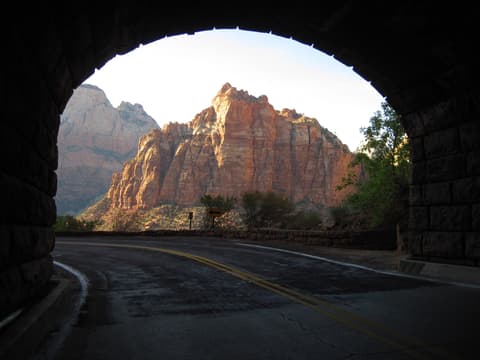
You are driving west on Highway 9, coming into Zion from the east entrance off Highway 89. The road has been winding through open desert plateau for a few miles — sage flats, red rock fins, a landscape that feels nothing like the slot canyons and towering walls you have been reading about. Then a massive dome of pale sandstone appears on your left, and you slow down without quite knowing why. Every car does. The face of it is covered in a perfect grid of intersecting lines, like someone drew it with a ruler. It looks deliberate. It looks geological and alien at the same time. That is Checkerboard Mesa, and almost nobody stopped at the pullout knows what they are actually looking at.
What Checkerboard Mesa Is
Checkerboard Mesa is a large Navajo sandstone dome sitting on the east side of Zion National Park, about 4 miles inside the east entrance. It rises roughly 900 feet above Highway 9 and tops out at around 6,520 feet in elevation. The formation is the same Navajo sandstone that makes up most of Zion's major walls — the same rock that forms the white and cream-colored upper cliffs throughout the park. What makes Checkerboard Mesa distinct is the crosshatch weathering pattern covering its exposed face, which is visible from the road and has no parallel anywhere else in the park.
The park sits within Kane County in southwest Utah. Zion National Park's standard vehicle entrance fee is $35 per vehicle, valid for 7 consecutive days, and the America the Beautiful annual pass covers entry. International visitors 16 and older pay a $100 per person surcharge added in January 2026 — card only, no cash at the gate.
The Geology: Why the Grid Exists
The crosshatch pattern is not an artistic trick of the light, and it has nothing to do with human activity. It is the result of two completely independent sets of fractures intersecting at roughly right angles, both carved deeper over time by weathering and erosion.
The vertical lines are joints — fractures that formed as the buried sandstone was subjected to pressure, then exposed as overlying rock eroded away. Thermal cycling accelerates the process: the bare rock face bakes under the desert sun during the day and cools sharply at night, expanding and contracting repeatedly until tiny fissures open and deepen into visible cracks. Water enters those cracks, freezes in winter, and widens them further. Over thousands of years, what started as microscopic stress fractures becomes a regular set of parallel vertical grooves spaced a few feet apart.
The horizontal lines are something different entirely. They follow the original cross-bedding of the ancient sand dunes that became this rock. About 180 million years ago, during the Jurassic period, this entire region was a vast erg — a desert of migrating sand dunes, comparable in scale to the modern Sahara. As those dunes shifted and stacked, each successive layer of sand was deposited at a slight angle. When the sand lithified into rock over millions of years, those original dune layers — now called cross-beds — became the weakest horizontal planes in the formation. Wind-driven sand and water erosion preferentially attack these softer interfaces, carving horizontal grooves that follow the original dune geometry.
When both sets of fractures erode simultaneously, the result is a grid. The pattern is purely geological — two different processes operating on two different sets of weaknesses, producing lines that cross each other at close to 90 degrees. The Navajo sandstone at Checkerboard Mesa is more than 2,000 feet thick in places across the Colorado Plateau, but this particular face happens to expose both fracture sets with unusual clarity and regularity.
The Pullout: What to Expect
There is a small parking area on the south side of Highway 9, directly across from the mesa face. It holds roughly 8 to 12 cars and fills up during peak hours in spring and fall. The stop takes 10 to 15 minutes if you are just viewing and photographing — there is no trail to the summit, no ranger station, and no facilities. This is a roadside viewpoint, not a trailhead.
For photography, the mesa face is roughly east-facing, which means morning light illuminates it directly and shows the crosshatch pattern at maximum contrast. By mid-afternoon the face is in full shadow, and the lines are harder to read. Overcast light works well if you want even exposure without harsh shadows. If you are driving from the east (coming from Kanab or Page), you will see the mesa on your left about 4 miles in — the pullout is right there. If you are driving east through the park from Springdale, the pullout appears on your right just before you reach the east entrance station.
No shuttle serves this section of the park. The Zion Canyon shuttle — which runs free and mandatory on Zion Canyon Scenic Drive from approximately March through November — does not operate on Highway 9 east of the Zion-Mount Carmel Tunnel. You need your own vehicle to reach Checkerboard Mesa.
East Zion: A Different Park
Most visitors spend their entire trip in Zion Canyon, which is the deep, narrow gorge on the west side of the Zion-Mount Carmel Tunnel. That section — the one with Angels Landing, The Narrows, and Emerald Pools — draws the crowds, requires the shuttle, and defines most people's mental image of Zion. The east side of the tunnel is a completely different environment.
Between the east entrance and the tunnel portal, Highway 9 traverses an open slickrock plateau. The walls are lower, the sky is wider, and the landscape feels more like the open canyon country of southern Utah than the enclosed drama of Zion Canyon. There are no shuttle stops, far fewer people, and an almost entirely different visual vocabulary — cream and white domes instead of rust-red vertical walls. If you drive through this section on your way to the main canyon without stopping, you are skipping a meaningful part of the park.
Checkerboard Mesa is the most recognizable feature in this section, but it is not the only reason to slow down. The slickrock surfaces along both sides of the highway show the same cross-bedded Navajo sandstone at smaller scale. Pull over anywhere that looks interesting and you will find the same geological story playing out across the terrain.
Pair It With Canyon Overlook Trail
If you want to add a hike to a Checkerboard Mesa stop, Canyon Overlook Trail is the obvious choice. It starts at the east portal of the Zion-Mount Carmel Tunnel — about 1 mile west of Checkerboard Mesa along Highway 9 — and covers 1.0 mile round trip with 163 feet of elevation gain. No permit required, no shuttle needed, and the view at the end looks directly into a section of Zion Canyon from the rim. The trail involves some exposed ledges with fixed handholds but is manageable for most visitors. Plan 45 minutes to an hour for the full out-and-back.
The practical sequence if you are entering from the east entrance: stop at the Checkerboard Mesa pullout first (10 to 15 minutes), then continue west to the Canyon Overlook trailhead and hike (45 to 60 minutes), then continue through the tunnel into Zion Canyon for the rest of your day. Our Trip Planning section covers shuttle logistics and canyon-side trail details once you are through the tunnel.
The Short Version
Checkerboard Mesa is what happens when two sets of rock fractures — vertical stress joints and horizontal dune cross-beds — erode at the same rate over millions of years. The grid is geological. The pattern is real. The pullout is worth 15 minutes of your drive even if you are in a hurry to reach the canyon. Stop, look at it, and you will have a better understanding of the rock you are walking on for the rest of your time in Zion.