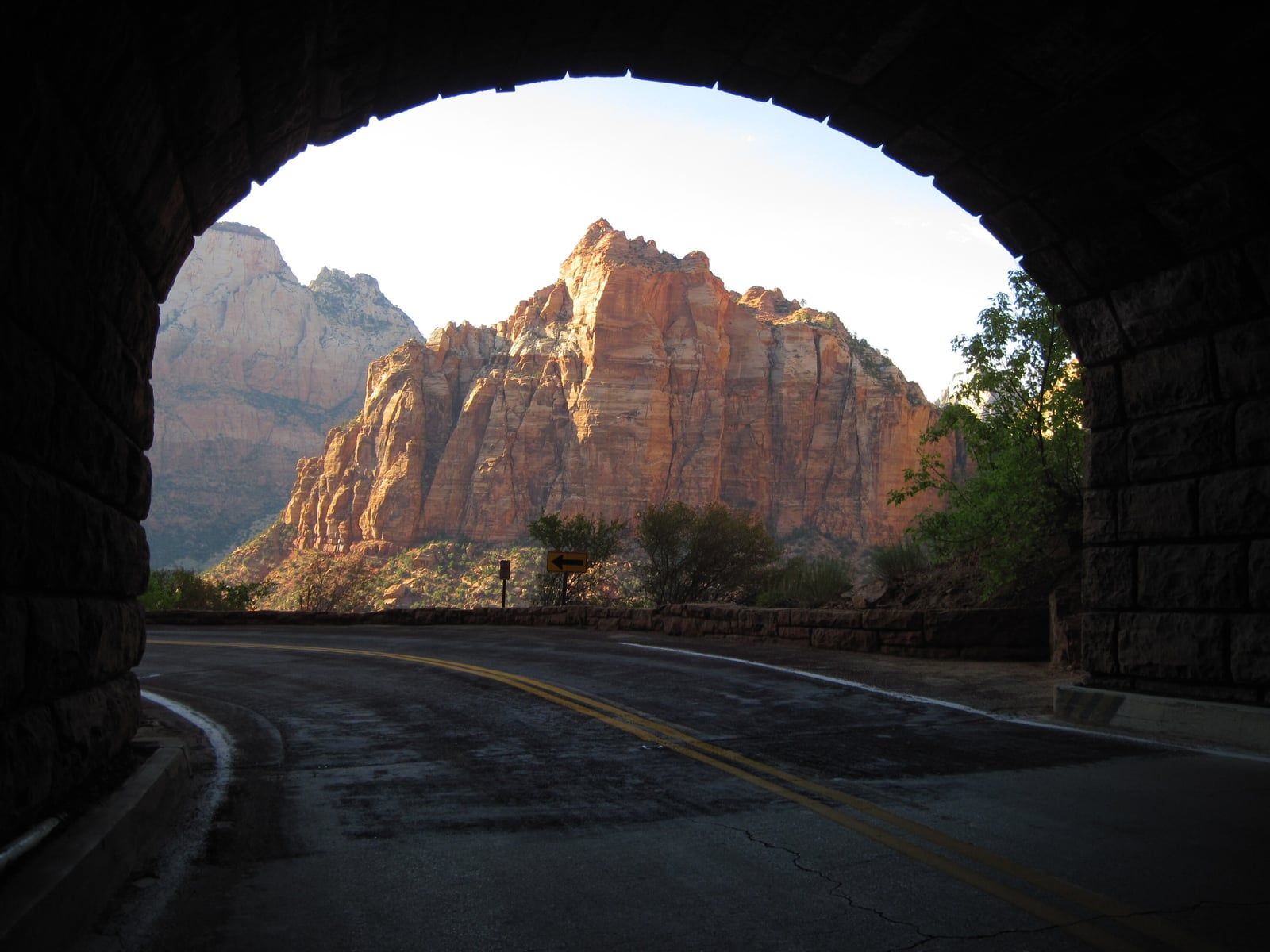
On June 7, the rules for driving across Zion changed for the first time in 37 years. So, can you drive through zion? If your vehicle is a rental sedan, a minivan, an SUV, or anything else that fits in a normal parking space, the answer is yes, same as always. You can still drive the Zion-Mt. Carmel Highway from Canyon Junction to the East Entrance, through the 1930 tunnel, up the switchbacks, past Checkerboard Mesa, and on toward Bryce or Kanab.
If your vehicle is large, the answer is now a permanent no. As of June 7, any vehicle over the size limits is banned from the entire highway, not just the tunnel. The $15 escort that used to walk big rigs through one at a time is gone, and there is no permit, exception, or workaround that brings it back. The whole question now comes down to four numbers and a tape measure.
The Four Numbers That Decide Your Route
A vehicle is banned from the Zion-Mt. Carmel Highway if it exceeds any one of these limits:
Length: 35 feet 9 inches (single vehicle); 50 feet combined for anything towing, with no more than 26 feet from hitch to rear axle
Width: 7 feet 10 inches, measured at the widest point
Height: 11 feet 4 inches, including everything on the roof
Weight: 50,000 pounds
The measurements include mirrors, tires, AC units, bike racks, and anything else bolted to the vehicle. Exceed one limit by an inch and the road is closed to you. There is no partial credit.
The numbers are not arbitrary. Safety studies in 1989 and 2019, both validated by the Federal Highway Administration, found that vehicles over the length limits cross the centerline at roughly 18 spots on the highway's switchbacks. Vehicles over the width or height limits cannot clear the tunnel walls while staying in their lane. And four historic bridges on the route are rated for 50,000 pounds, full stop.
The tunnel itself is the reason any of this exists. It runs 1.1 miles through solid sandstone, opened in 1930, and was engineered for the vehicles of 1930. For 37 years the park papered over that mismatch with the escort system: rangers stopped oncoming traffic so oversized rigs could straddle the center of the tunnel. It worked, in the sense that nobody got wedged. It also strangled the road. A 2016 study found the escort left an average of 19 minutes of free-flowing traffic per hour at the tunnel. On the busiest day measured, it was 8 minutes. The park spent the other 52 escorting vehicles through one direction at a time.
Will Your Vehicle Fit? A Field Guide
Rental cars, sedans, minivans, crossovers, standard SUVs. Yes. Nothing about your trip changed. Drive the highway whenever you want, no permit, no time restrictions, two-way traffic through the tunnel.
SUV with a rooftop cargo box. Almost certainly yes. A standard SUV with a roof box sits around 8 feet tall, well under the 11-foot-4 limit. Watch wide accessories more than tall ones.
Full-size pickup with towing mirrors. This is the trap. The 7-foot-10 width limit, measured mirror tip to mirror tip, catches nearly every heavy-duty pickup with towing mirrors extended, along with dually trucks on rear-axle width. (Folding the mirrors in does not earn you a waiver. The limit is the limit, and the rangers at the gate carry tape measures, not judgment calls.) If you tow for a living, measure before you route through the park.
Campervans and Class B vans. Usually yes, barely. A stock Sprinter runs about 7 feet 8 inches mirror to mirror, which clears the width limit by two inches. Standard and high-roof versions both clear the height limit. The risk is the add-ons: roof-mounted AC, solar panels, and racks can push a converted van over 11 feet 4 inches. Measure the actual vehicle, not the brochure.
Class C and Class A motorhomes, fifth wheels, most travel trailers. No. Class C and A bodies run 8 to 8.5 feet wide before mirrors, which fails the width limit on its own. Most rental RVs from the major fleets fall in this category. Travel trailers frequently fail on combined length even when the trailer body itself is modest. One driver's report from the rule's rollout: a midsize trailer that came up 1 inch too tall, 2 inches too wide, and 9 inches too long once hitched.
Box trucks, horse trailers, boat trailers. Box trucks are typically too tall and too wide. Horse and boat trailers depend entirely on combined length and width, and many fail. Measure the full rig, hitched.
If you are not sure, measure everything: total height including roof gear, total width at the mirrors, total length including racks and spare tires, and the hitch-to-rear-axle distance on anything towed. Manufacturer spec sheets exclude the add-ons that put you over.
If Your Vehicle Is Over the Limit
You can still visit Zion. You just cannot drive across it. Enter through the South Entrance near Springdale, and you have three parking options in order of preference: the free oversize lot just inside the entrance (fills early on busy mornings), Lion Boulevard in Springdale ($30 per day for vehicles over 24 feet), or the Virgin Park & Ride 15 miles west, which has 8 free oversized spaces and a $5 shuttle into town. From any of them, the free park shuttle handles the rest of your day in Zion Canyon. Our Getting Around guide covers the shuttle system and parking zones in detail.
What you lose is the east side by car: Canyon Overlook Trail, Checkerboard Mesa, and the direct route to East Zion outfitters are all past Canyon Junction, on the restricted highway. There is no park shuttle through the tunnel. If the east side matters to your trip and your rig is oversized, either bring or rent a compliant vehicle for that day, or base on the east side and use a local operator's shuttle.
If you are continuing past Zion, the detours are paved, RV-safe, and shorter than you would guess. Heading to Bryce Canyon or Cedar City, take I-15 north to UT-20, then US-89 south, which adds about 42 minutes compared to the park route. Heading to Kanab or the Grand Canyon North Rim, take UT-59 through Hurricane to AZ-389 to US-89, which adds about 10 minutes. Ten. The tunnel route was never fast; it was just direct. Our How to Get to Zion guide covers the regional routes.
One warning that matters more than it should: do not let your GPS improvise. Navigation apps have been routing large vehicles onto Sheep Bridge Road and Smithsonian Butte Road as tunnel workarounds. Both are dirt, both are steep in sections, and both are impassable when wet. The NPS warns against them explicitly. Stay on the numbered highways.
The Drive Is Actually Better Now
Here is the part the headlines skip: for everyone in a compliant vehicle, which is the overwhelming majority of visitors, the Zion-Mt. Carmel Highway just became a better drive. Two-way tunnel traffic is restored. The escort backups that consumed 40-plus minutes of every peak-season hour are gone. The east side (the switchbacks, the slickrock, Checkerboard Mesa, the Canyon Overlook Trail with its 1-mile walk to a view that rivals anything on the shuttle route) is easier to reach by car than it has been in decades.
Measure your vehicle once, honestly, with the mirrors and the roof gear included. If you clear all four numbers, drive the highway and enjoy a road that finally flows. If you do not, park at the south side, ride the shuttle, and map the paved detour before you leave. Check the NPS conditions page the morning you travel, because signage and enforcement details are still settling in the rule's first weeks. Browse Getting Around and Things to Do on Zion Travel for shuttle logistics and east side trip plans.

